
AI
A shopping assistant that knows how to say “I don’t know”
· 6 min read · By Ray Rodríguez, founder of Findalo
The number one objection when you show an AI assistant to a merchant isn't the price. It's this: "and what if it makes something up?"
It's a good objection. An assistant that promises a customer 24-hour delivery you don't offer, or assures them a product is coeliac-safe when nobody has checked, isn't a feature: it's a legal problem with a friendly face.
This post explains how ours is built so that doesn't happen, what it does when it doesn't know something — which is the interesting part — and when you shouldn't buy it.
It talks about your catalogue, not about the internet
The fundamental difference from a generic chat you paste your website into is where it gets what it says.
Our assistant uses exactly the same index as your search. The same products, the same prices, the same stock, the same languages, updated by the same sync. When it recommends something, it recommends one of your SKUs that exists and can be bought at that moment.
That has two practical consequences. The first is that there's no second catalogue to maintain or re-upload when you change prices. The second, and more important: it can't recommend what you don't sell, because it doesn't have it in front of it.
It also reads the pages of your store where the terms live: shipping, timescales, returns, warranty. Those are the questions any store assistant gets most, and without them the chat is a tour guide who doesn't know how to get anywhere.
What happens when it doesn't know
Here's the part we find most valuable, and it's the exact opposite of what usually gets sold.
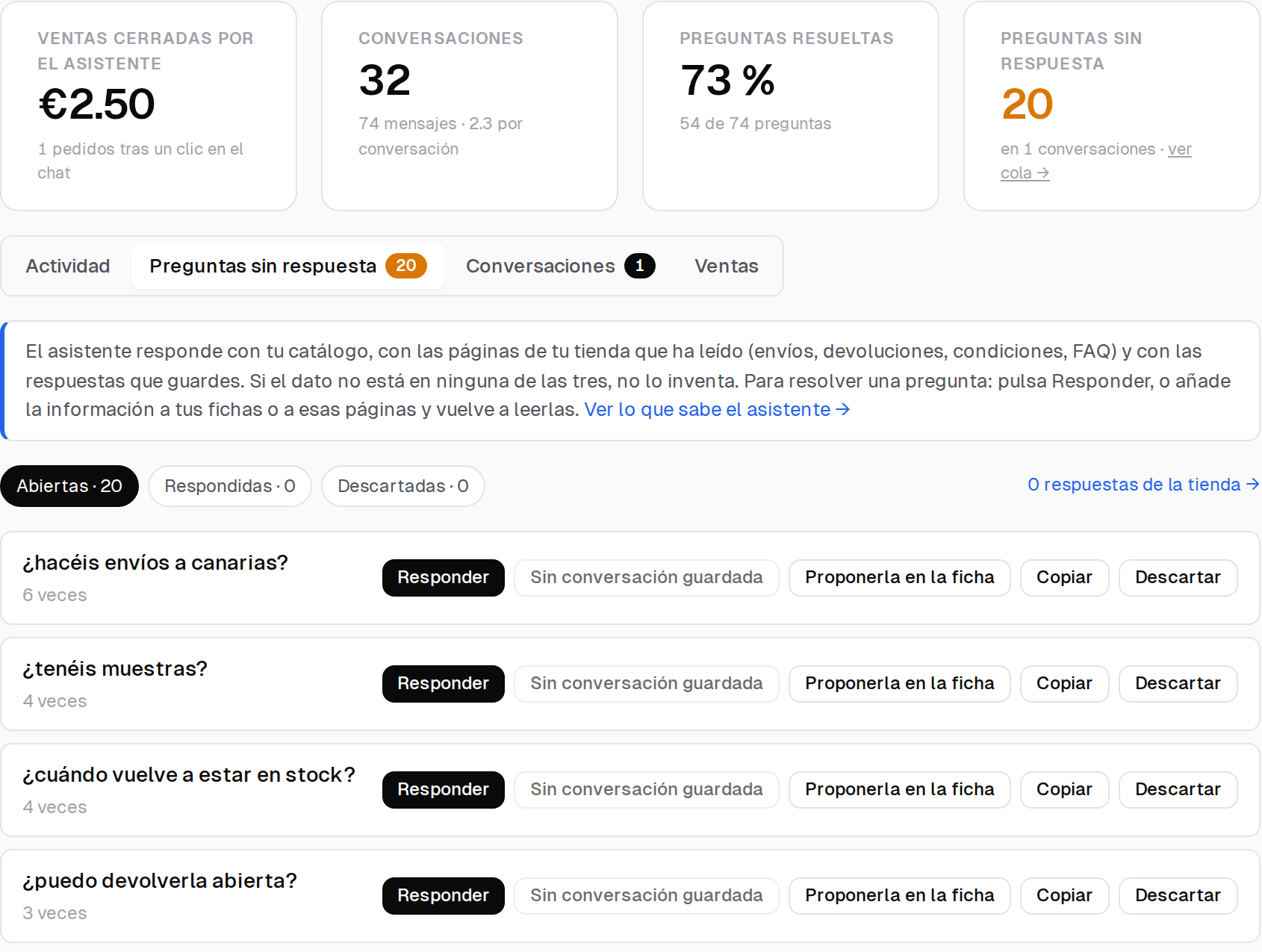
When someone asks something that's neither in your catalogue nor on your pages, the assistant says it doesn't know and offers whichever way out applies: another way to look for it, or talking to a person.
And that question gets recorded.
The list of what the assistant couldn't answer is, in practice, the report of what your store is missing. Not what you think is missing: what your customers actually asked, sorted by how many times they asked it. We've seen that list turn into three new paragraphs on a shipping page and into the disappearance of an entire category of emails to customer service.
An assistant that never says "I don't know" isn't better. It's one that isn't telling you when it's making things up.
Where it lives in your store
In two places, and they're worth telling apart because people confuse them.
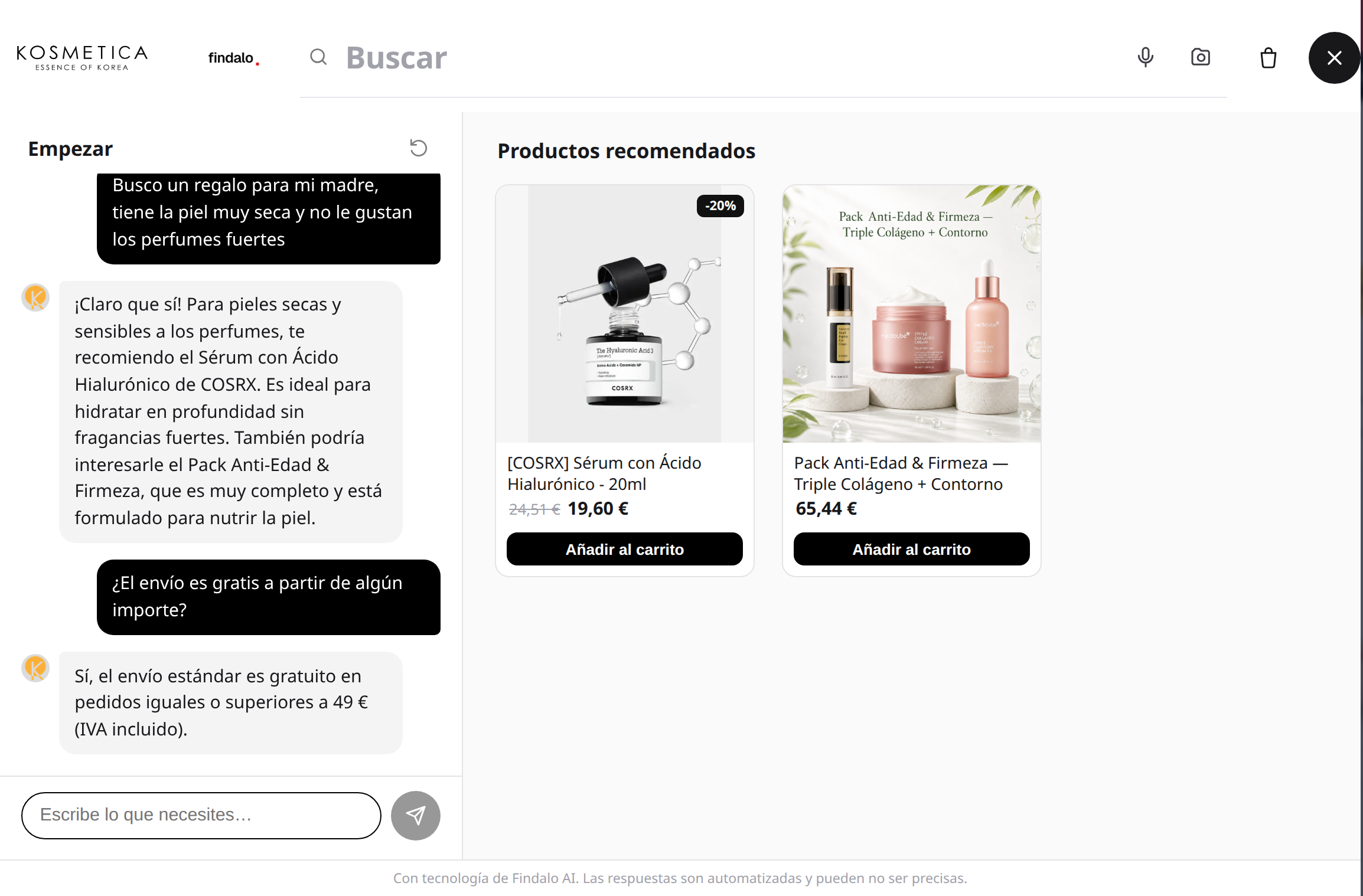
One is the chat: the shopper asks in their own words, the assistant asks back whatever it needs, and ends up proposing specific products. It's the conversation they'd have with your shop assistant.
The other is the help block on the product page: the customer is looking at something specific and has a question about that, without wanting to open a conversation. It's where it gets used most and where people expect it least.
What it costs
The shopping assistant is included from the Business plan up (€149 a month). And if you're on Starter or Pro and want it without changing plan, it's sold separately at €49 a month, from your dashboard, in two clicks, and removed the same way.
It's the only feature we sell à la carte, and there's a reason: it's the one most people want without needing the rest of the jump in plan.
The comparison that matters isn't against having nothing, it's against the usual alternative, which is buying a separate AI chat and pasting your catalogue into it. That's two subscriptions, two places to keep prices up to date, and two opportunities for them to drift apart.
When not to buy it
Three cases, and we say them before charging.
If your catalogue is badly described, the assistant will be bad. That isn't an opinion: if your product pages have a name and two lines, there's no information with which to answer "is this suitable for sensitive skin?". You'll notice straight away, because the list of unanswered questions will be full of things you do sell.
If your catalogue is very small, you don't need it: with two hundred SKUs, good navigation and a decent search cover the same ground.
And if what you need is customer service — order status, incidents, returns already in progress — this isn't that. It's a shopping assistant: it helps people choose. For the rest you need a person or another tool.
Before deciding
If you want to see it with your own products, we'll set it up with your catalogue and send you the link, free. That way you see the kind of questions it resolves with your real product pages, which is the only thing that genuinely answers the doubt.
Write to us and we'll prepare it.
Keep reading
-
Purchase intent: let the search find "the love stone" even if the product page doesn't say so
For every product and in every language, the AI writes the phrases a shopper would use to ask for it: what it's for and what people call it. Real examples from a minerals shop, a medical instruments catalogue in German and a chain of shoe shops. Included from Pro up, with nothing to configure.
-
Free 1-month trial: what's included and what happens when it ends
200 products, 1,000 searches in total and no card. When the month or the searches run out, search stops responding and, if you don't move to a paid plan, the account is deleted 30 days later. What we warn you about, how to continue with Starter or Pro (14-day free trial), and when the trial won't help you decide.